Saturday, October 8, 2011

War on Drugs and Incarceration Rate

In a few posts, I've commented on the War on Drugs and called it a waste of tax payer money. Today, I'd like to conduct a little deeper of a dive into the subject...

The statistics around incarceration rates in the US are rather impressive. The percentage of Americans in our prison systems has been rising exponentially since the 1980's, which coincides with the start of the War on Drugs, specifically the Anti-Drug Abuse Act of 1986 (see chart below). Even more depressing, the US incarcerates more people than any other nation in the world weighing in at 2.4MM inmates. To put this into perspective, China's population is nearly 4x ours and their prisons hold 1.6MM.


There are a couple major drivers in this incarceration rate increase. First, the US has longer sentencing periods than other nations, which drives up the rate. Second, the Anti-Drug Abuse Act of 1986 included mandatory minimum sentencing for drug related offenses. As a result US prisons went from holding 40,000 inmates due to drug related crimes in 1980 to approximately 500,000 in 2011.

A 2008 study shows the US spends $44B annually on law enforcement for the War on Drugs plus an annual cost of $11B to imprison offenders. On top of this, the US provides other countries funding to fight drug totaling in the hundreds of millions. Obviously, there are significant resources being deployed in this effort. The question is, is it worth it?

The good news is, immediately following the passing of the Anti-Drug Abuse Act, there was a modest decline in the recurring use of narcotics (see below or follow this link). Unfortunately, the use has been trending upwards, although just slightly. A review of the numbers shows the relative drug use pre and post passing of the Act to be about 2MM people. The number of people who become addicted and subsequently ruin their lives is only a fraction of the 2MM.
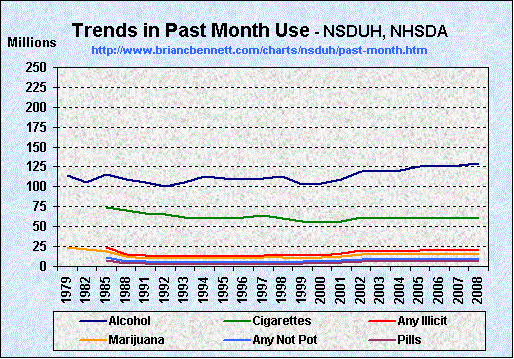


Again, is $55B+ annually worth it? To put it another way, the current US population is 307MM. Does it make sense to force the remaining 305MM (99.3%) to pay $55B, in a deficit spending fashion, on a venture which may keep 0.7% from engaging in recreational drug use??? For me, the response is an emphatic NO.

So far, I've focused only on the economic impact of the War on Drugs. A much more emotional argument could be made for the cost in lives lost due to the drug cartels created by our laws. The legalization of drugs would almost immediately undermine the power of drug dealers/cartels, not to mention potentially infuse the US economy with an estimated $30B+ in tax revenues. Those revenues plus the reduction in tax payer liabilities would be an excellent start to reduce our deficit and, more importantly, would be a step closer to a truly free society.

In summary, the War on Drugs is a poor investment of resources. It is modern day prohibition, and just like prohibition in the 1920's, it is a futile and violent effort. Individuals in a free society should have the right to engage in whatever activity they so choose, as long as it does not infringe on other peoples' life and property (especially in their own homes). The data shows this policy does not make our country more safe and the cost  associated certainly does not make us more prosperous. It is government over-reach of the worst kind: it infringes on our lives, liberty, and prosperity.

Tuesday, October 4, 2011

Liberals, Conservatives, and Libertarians

I find it interesting the political viewpoints we all have and our reasoning behind our views. I've learned over the years, by and large, people are genuine with their beliefs; they truly feel their political views are in the best interest of most everyone involved and they're not looking to coerce people into unfortunate situations. That being said, I think we often overlook some basic truths and are often very inconsistent with our opinions.

For example, people often referred to as leftists or liberals are often anti-war, support freedom of personal choice (i.e. legalization of marijuana), tolerance, and diversity. All of which I also support and find to be foundations to any truly free society. However, these same individuals do not favor economic freedom of choice. Individuals in this general category are advocates of a progressive tax, welfare programs, and other public subsidies. This viewpoint tends to ignore the simple fact that government does not have any wealth of its own to redistribute and finds it perfectly acceptable to use government force to fund certain programs. As I mentioned before, I do not question the motives of individuals with this viewpoint. The intent is to help those in need and this is not at all what I question. I simply suggest the means do not justify the end and have a hard time reconciling how one can be an advocate of social freedom but not economic freedom.

On the other side of the American spectrum, we have those on the right - the conservatives. The general stated viewpoint is government should be small, people should be given economic freedom, and government should stay out of the way of the people. Again, these are also what I view to be key components to a free society. However, people with this viewpoint tend to want to use the government to prevent gay marriage and support the War on Drugs. Again, this seems to be a conflicting set of principals to me.

My opinion is if we want a truly free society, we have to be equally committed to social and economic freedom. I find when I say this to many people, the response I get leads me to believe they are interpreting "free society" as anarchy, and that is not what I view a free society to be. In a previous post, I mentioned what I view to be the fundamental role of government. The top two reasons for government should be 1) defend individual property rights and 2) defend the individuals right to life and to freedom to pursue happiness. With these top two functions in mind, a government in a free society still prosecutes murderers, thieves, and those committing acts of fraud and it still provides a military for the common defense. A free society is not anarchy.

Unfortunately, both mainstream parties have views which I see as rather glaring inconsistencies with a free society. This is why I tend to find myself agreeing more and more with Libertarians. Libertarians are opposed to legislation on same sex marriage, see the War on Drugs as a massive waste of tax payer money and an attack on personal freedom, and they also are against using government force to fund social welfare programs. Yes, advocating a free society means acknowledging that individuals have a right to behave as they wish, even irresponsibly, as long as it does not infringe on another individual's life or property. It also means that people should be given the freedom to spend their money as they wish and to help those they choose to help. If people were truly allowed to do so, without any government regulation favoring one group vs. another, I believe this would lead to a peaceful and economically sound society.

Saturday, October 1, 2011

Collective Bargaining and Ohio Senate Bill 5

Ohio's controversial Senate Bill 5 is a political lightning rod. When I think about this bill and how I may vote this November, I believe I have to a) consider the fundamental role of government and b) consider the constitutional rights of American citizens to participate in collective bargaining. For what I see as a fair summary of the bill's impact to labor union's in the public sector,please see this article.

There are certainly several topics to discuss concerning the bill. My perception is the Republicans would like to focus on requiring public sector employees to receive pay increases based on merit and pushing more of the health care costs back onto the employees to be more in line with the private sector. Democrats would like us to focus on provisions in the bill which forbid police officers and fire fighters from negotiating on what they consider to be safety issues. These are certainly fair topics to discuss but I can't help but notice a two basic realities which make me uncomfortable with this entire issue.

The first issue I have with the bill is I believe limiting the rights of individuals to collectively bargain on any issue to be unconstitutional. The first amendment is clear in saying: "Congress shall make no law respecting an establishment of religion, or prohibiting the free exercise thereof; or abridging the freedom of speech, or of the press; or the right of the people peaceably to assemble, and to petition the Government for a redress of grievances." The provision of the bill which essentially makes it a criminal offense for public sector employees to strike, punishable by heavy fines, is especially concerning. I think these implications alone are enough to vote against this bill, and if it weren't for my second concern with this issue, I would vote 'No' on issue 2 without any reservation.

My hesitation is due to the second reality which makes me uncomfortable with this issue: forced union dues. Ohio teachers, police offers, fire fighters and others are required to pay union dues for their "privilege" to work and earn a wage. I also find this to be unconstitutional. The ninth amendment states: "The enumeration in the Constitution, of certain rights, shall not be construed to deny or disparage others retained by the people." Meaning, the right to collectively bargain does not give the labor unions the power to require all individuals who wish to be a teacher, police officer, fire fighter, etc. to join their union. As a result, I have a very difficult time supporting the  rights of a union which I believe has core practices which are unconstitutional.

What I would like to see is a state law or a federal ruling banning forced dues. People have a right to collectively bargain voluntarily and employers (government and private) should be given the choice as to whether or not they wish to negotiate with the union. I know there are public sector workers which would gladly negotiate with their employer on their own. Labor unions have every right to exist and to bargain on behalf of their members; they do not have the right to a forced monopoly of their labor market.

The sad reality is Ohio voters are being forced to choose between a government which infringes on the rights of its citizens or a union which infringes on the rights of its members. It's a classic case of the lesser of two evils. All that being said, I have several friends and family members which are impacted by this bill. While I vehemently disagree with several of their respective union's practices (i.e., raises, layoffs, etc. based on seniority instead of merit), I recognize and support their right to collectively bargain. The members who are forced to join their union are already having their rights violated by their union; I will not support a law which will add the additional injustice of their government violating their freedom of association.

Yes, it is fair to say the labor unions potentially drive up costs on the taxpayers. However, the response or remedy cannot include the violation of any individual's first amendment rights.